

Most people pick jewelry by what catches their eye first. A pretty pendant, a trending bracelet, something that feels right in the moment. But matching personalized jewelry to personality is a different practice entirely. It asks a deeper question: does this piece actually say something true about who you are? Jewelry designers and style psychologists call this self-concept congruence, the idea that what you wear should align with your inner identity, not just your outfit. This guide walks you through how to read your own personality signals, translate them into style choices, and build a collection that feels genuinely yours.
Table of Contents
- Key Takeaways
- Matching personalized jewelry to personality: the psychology behind it
- How to assess your style signals before you shop
- Choosing and customizing pieces that reflect your identity
- Common mistakes when choosing personality-driven jewelry
- Building a collection that grows with you
- My honest take on jewelry and identity
- Find your perfect piece at Glamourjewelryhouse
- FAQ
Key Takeaways
| Point | Details |
|---|---|
| Personality drives style preferences | Your traits like introversion, spontaneity, or structure directly shape which jewelry styles feel authentic to you. |
| Self-assessment before shopping | Identifying your style signals before buying prevents impulse purchases that miss the mark. |
| Personalization amplifies meaning | Engravings, birthstones, and symbols turn a piece into a story only you can tell. |
| Gifting requires their lens | Choosing customized jewelry for gifts means studying the recipient’s personality, not your own taste. |
| Collections evolve with you | Editing your jewelry regularly keeps your collection aligned with who you are becoming, not just who you were. |
Matching personalized jewelry to personality: the psychology behind it
Jewelry has always been more than decoration. It signals identity, communicates values, and reflects emotional states. Jewelry expresses mood and identity in ways that go far beyond aesthetics. In fact, 67% of consumers want their jewelry to express their personality and mood, not just look beautiful.
The psychological framework behind this is self-concept congruence. Simply put, we feel more confident and comfortable wearing pieces that reflect who we believe ourselves to be. When your jewelry aligns with your identity, it acts as a daily confidence signal, something researchers sometimes call dopamine dressing.
Personality frameworks like the Myers-Briggs Type Indicator (MBTI) offer a useful starting point for understanding jewelry and personality traits. Consider these broad dimensions:
- Extroverts tend to gravitate toward bold, statement-making pieces. Think layered gold chains, chunky rings, or oversized hoops that invite conversation.
- Introverts often prefer understated, meaningful pieces worn close to the body. A delicate name necklace or a small birthstone ring communicates depth without demanding attention.
- Structured, organized personalities (Judging types) often build a consistent, uniform jewelry wardrobe. They wear the same pieces daily because those pieces feel like part of their identity.
- Flexible, spontaneous personalities (Perceiving types) love eclectic stacking, mixed metals, and swapping pieces based on the day’s energy.
Research shows that jewelry communicates personality more than most wearers realize. A person who stacks mismatched rings signals spontaneity and creativity. Someone who wears one elegant pendant every single day signals consistency and intentionality. Neither is better. Both are honest.
Pro Tip: If you are unsure where to start, look at the jewelry you already reach for automatically. The pieces you wear most often are your clearest personality signals.
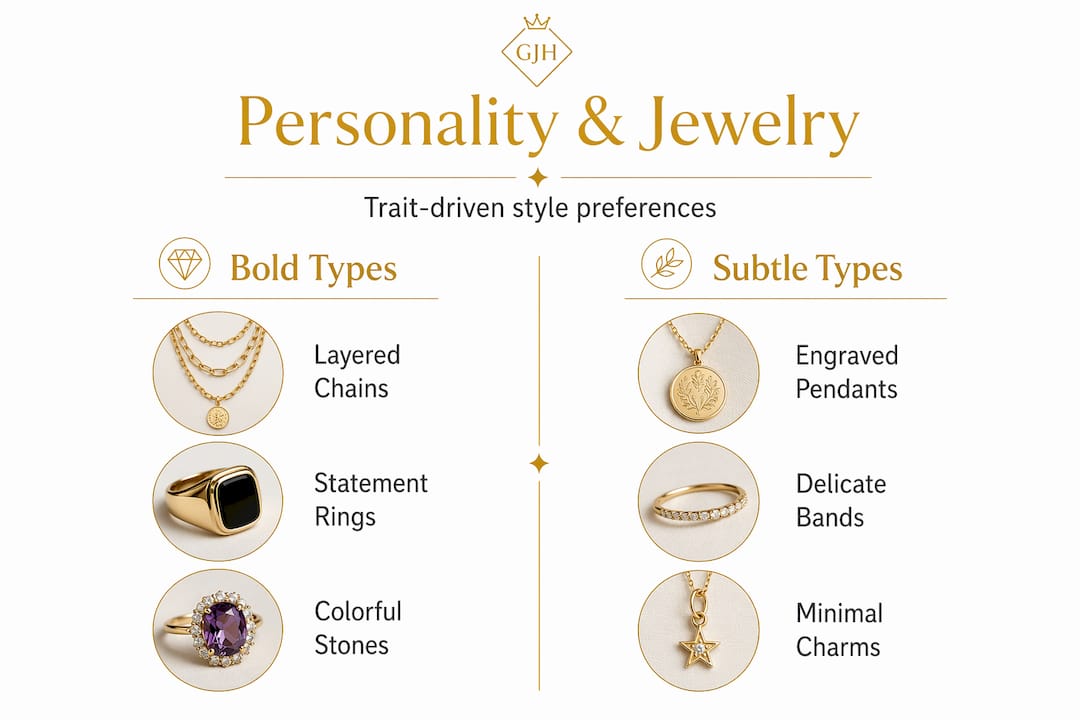
Here is a quick reference for how personality dimensions map to jewelry preferences:
| Personality trait | Preferred jewelry style |
|---|---|
| Extroverted, bold | Statement necklaces, layered chains, large hoops |
| Introverted, thoughtful | Delicate pendants, birthstone rings, engraved pieces |
| Organized, consistent | Uniform daily pieces, classic metals, minimal variety |
| Spontaneous, creative | Mixed metals, eclectic stacking, symbolic charms |
| Sentimental, relational | Name pieces, birthstones, meaningful date engravings |
How to assess your style signals before you shop
Before you spend a single dollar on a new piece, spend ten minutes on honest self-reflection. This process is more useful than any trend report.
- List the pieces you actually wear. Not the ones you own. The ones you put on without thinking. These are your authentic style anchors.
- Notice the patterns. Are they gold or silver? Minimal or layered? Symbolic or purely aesthetic? The pattern reveals your instinctive preferences.
- Identify your dominant personality traits. You do not need a formal test. Ask yourself: Do I prefer blending in or standing out? Do I like consistency or variety? Am I drawn to sentimentality or sleek design?
- Map those traits to a style axis. Think of it as a spectrum between two poles: bold versus delicate, cohesive versus eclectic, classic versus symbolic. Most people land somewhere in the middle, and that is where personalization becomes powerful.
- Ask one honest question. “Does this piece tell a true story about me, or am I buying it because someone else looks great in it?” Trends are not bad. Wearing them when they do not reflect your personality is where the disconnect happens.
Choosing jewelry that fits personality creates a signature style that resonates on a deeper level than trend-chasing ever will. A piece that reflects who you are will still feel right in five years. A trend piece often feels hollow within five months.
Pro Tip: Think about what jewelry suits your personality by identifying one word that describes your personal style. Romantic, minimal, bold, symbolic. Let that word guide every purchase decision.
Choosing and customizing pieces that reflect your identity
This is where the real magic happens. Personalized jewelry styles exist on a wide spectrum, and understanding your options helps you make choices that carry genuine meaning.
The most common personalization formats are:
- Name necklaces: Deeply personal and immediately recognizable as yours. Great for sentimental personalities who want their jewelry to feel like a signature.
- Birthstone pieces: These carry layered meaning. Your own birthstone reflects your identity. A loved one’s birthstone reflects your relationships. A custom name necklace with birthstone combines both in one piece.
- Engraved bracelets or rings: A date, a word, a set of coordinates. Engraving is the most personal form of customization because it hides meaning in plain sight.
- Symbolic charms: Faith symbols, protective symbols like the evil eye, nature motifs. These work beautifully for personalities who communicate through metaphor rather than literal expression.
When it comes to budget, personalized jewelry breaks down into three tiers: under $150 for accessible engraving and simple stones, $150 to $800 for mid-range custom work, and $800 and above for investment pieces. Most meaningful personalization, including engraving and birthstone settings, falls comfortably within the first two tiers.
For durability, engraving is the most lasting personalization method. Deep, simple fonts maintain legibility far longer than ornate script. If you are engraving something meant to last decades, choose a clean sans-serif or block font over decorative calligraphy.
The 2026 styling trend favors bold, mixed metals and storytelling over overly matched minimalism. Statement pieces paired with personal everyday jewelry communicate individuality in a way that uniform sets simply cannot.
Pro Tip: When personalizing a piece for lasting identity expression, choose one element that is timeless (a name, a date, a symbol) rather than something trend-dependent. Trends fade. Your story does not.
Common mistakes when choosing personality-driven jewelry
Even with the best intentions, people make predictable errors. Knowing them in advance saves real money and real disappointment.
- Buying for yourself when gifting. The largest risk in jewelry gifting is choosing based on your own taste rather than the recipient’s personality. You might love bold gold chains. Your friend might wear only delicate silver. Study their existing jewelry before you buy.
- Choosing identical matching sets. Matching jewelry is most effective when pieces are coordinated but not identical. One partner wearing a bold cuff while the other wears a delicate version of the same design communicates connection while honoring individuality. Perfectly identical sets often feel like a costume rather than a personal statement.
- Skipping the self-reflection step. Impulse purchases feel exciting for about a week. Pieces chosen with intention feel right for years.
- Ignoring durability in personalization. A beautifully engraved piece on low-quality metal will tarnish and degrade, taking the meaning with it. Material quality matters as much as the personalization itself.
“The most meaningful piece of jewelry you own is probably not the most expensive one. It is the one that tells a story only you understand.”
Pro Tip: When buying customized jewelry for gifts, look at what the recipient wears to work, on weekends, and to special occasions. Three different contexts reveal three layers of their personality.
Building a collection that grows with you
A great jewelry collection is not built in one shopping trip. It grows the same way your identity does: slowly, intentionally, and with occasional editing.
Start with a signature piece. This is your anchor. It might be a name necklace, a birthstone pendant, or a symbolic charm that captures your core identity. Everything else you add should either complement it or express a secondary trait.
From there, build outward:
- Add pieces that express different facets of your personality. A bold ring for confident days, a delicate chain for quieter ones.
- Experiment with mixed metals and layering, which 2026 trends confirm as the dominant direction for personal style expression.
- Periodically edit your collection. A personality-true collection requires removing pieces that no longer feel authentic, prioritizing coherence over quantity.
The goal is not a large collection. It is a true one. Every piece should earn its place by reflecting something real about you.
| Collection stage | Focus |
|---|---|
| Foundation | One signature piece that anchors your identity |
| Expansion | Secondary pieces expressing complementary traits |
| Refinement | Editing out pieces that no longer feel authentic |
| Evolution | Adding pieces that reflect who you are becoming |
Pro Tip: Once a year, lay out every piece you own. Anything you have not worn in twelve months and cannot explain why you love it should be gifted or sold. Clarity in your collection creates clarity in how you present yourself.
My honest take on jewelry and identity
I have spent years watching people choose jewelry, and the pattern I keep seeing is this: the pieces that disappoint are almost always the ones chosen in a rush, chasing something external. A trend, a sale, someone else’s approval.
What I have learned is that the most powerful jewelry choices come from a moment of genuine self-recognition. You see a piece and think, that is me. Not “that is beautiful” or “that is popular.” That is me.
I used to think personalization was mostly about aesthetics, about adding a name or a date to make something feel special. But I have come to believe it goes deeper than that. When you engrave a word that only you understand, or choose a stone that carries a private meaning, you are not just decorating yourself. You are making a quiet declaration about what matters to you.
The clients I have seen build truly satisfying collections share one habit: they edit ruthlessly. They are not afraid to let go of pieces that no longer reflect who they are. That willingness to evolve is what keeps their style feeling alive rather than frozen.
My advice? Start with one piece that tells a true story. Build from there. And trust that your instincts, when you slow down enough to hear them, know exactly what you need.
— Tony
Find your perfect piece at Glamourjewelryhouse
If this guide helped you see your style more clearly, the next step is finding pieces that actually deliver on that clarity.
At Glamourjewelryhouse, every piece is handcrafted in 18K gold vermeil with a sterling silver base and a 5x thicker gold layer that resists tarnishing for over two years. The collection includes engraved name necklaces, birthstone pendants, and symbolic pieces like the personalized evil eye necklace and the emerald birthstone pendant, each designed to carry real personal meaning. With a 2-year warranty, 60-day returns, and over 21,000 five-star reviews, you can shop with confidence. → Explore the full personalized collection and find the piece that tells your story.
FAQ
What does “matching jewelry to personality” actually mean?
It means choosing pieces that reflect your identity traits, values, and emotional expression rather than just current trends. The concept is rooted in self-concept congruence, the psychological idea that we feel most confident wearing things that align with who we truly are.
What jewelry suits my personality if I am introverted?
Introverts typically connect most with delicate, meaningful pieces worn close to the body, such as engraved pendants, birthstone rings, or small symbolic charms. These pieces communicate depth without demanding attention.
How do I choose personalized jewelry as a gift?
Study the recipient’s existing jewelry before buying. The biggest gifting mistake is choosing based on your own preferences rather than theirs. Look at what they wear daily and let their style signals guide your choice.
Is engraving a good personalization option for lasting wear?
Yes. Engraving is the most durable and cost-effective personalization method, especially when paired with a simple, clean font and quality base metal. Ornate scripts wear down faster and lose legibility over time.
How often should I update my jewelry collection?
A yearly edit is a healthy practice. Remove pieces you have not worn in twelve months and that no longer feel true to who you are. A smaller, more intentional collection always feels more personal than a large, unfocused one.
Recommended
- Personalized Emerald Necklace | Custom Gold Emerald Birthstone and Name Pendant | 18K Gold | May Birthstone Identity Gift – Glamour Jewelry House
- Personalized & Handcrafted 18K Gold Jewelry – Glamour Jewelry House
- Personalized Evil Eye Necklace | Custom Gold Evil Eye with Engraved Name Pendant | 18K Gold | Symbolic Identity Gift – Glamour Jewelry House
- Custom Name Necklace with Birthstone | Fully Personalized Gold Custom Name and Birthstone Pendant | 18K Gold | Identity Birthstone Gift – Glamour Jewelry House


